Applies to: Floating production & moorings →
⚠ Illustrative viewpoint, written to demonstrate the resource hub.
Mooring integrity is one of the highest-consequence items in floating production. The industry has invested heavily in inspection and monitoring. Far less attention goes to a mundane prerequisite: being certain which component you are inspecting.
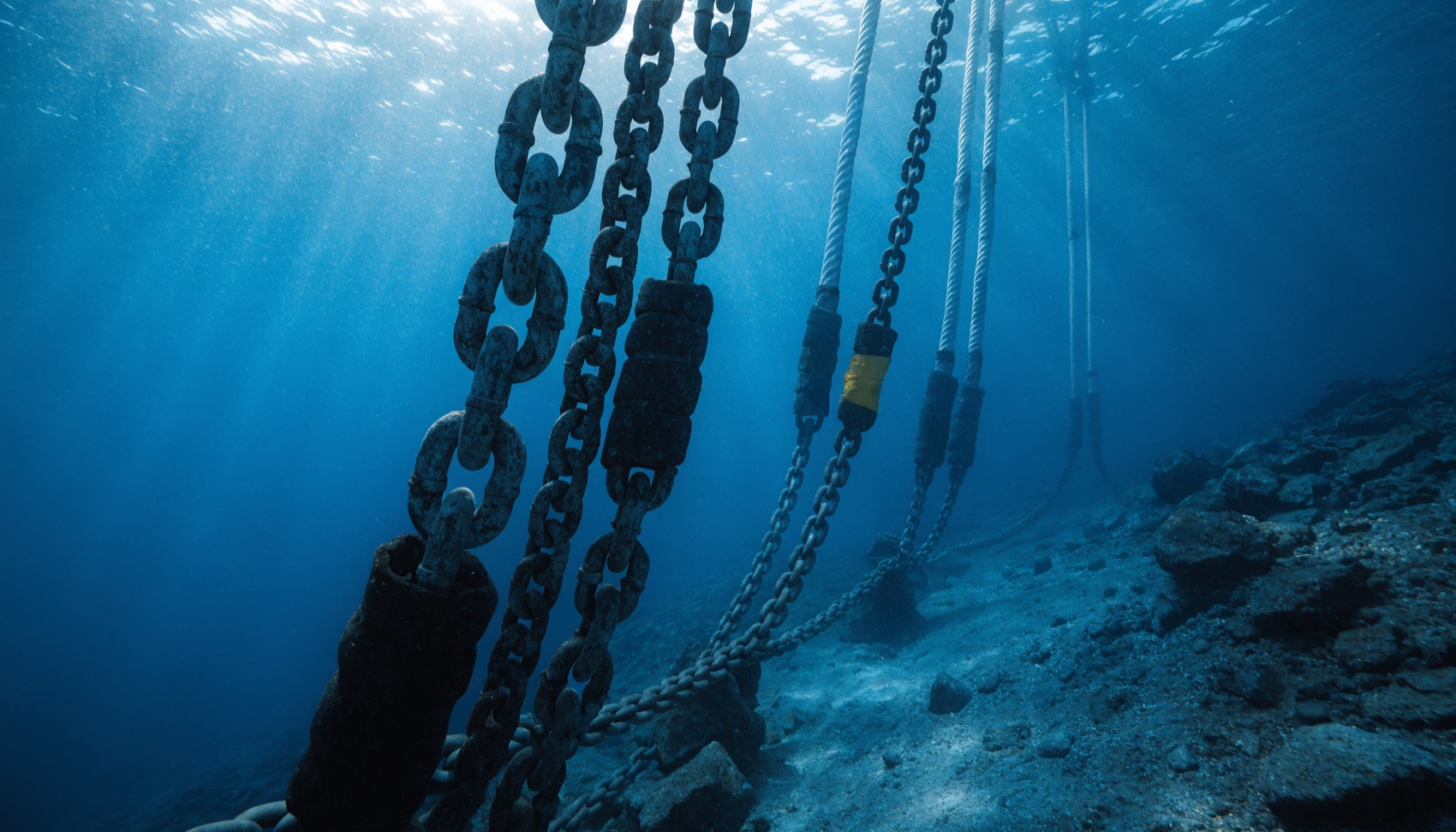
Anchor-leg failures tend to occur in predictable places: at or near the fairlead, at interfaces with connectors and support buoys, and in the touch-down area. Inspection is a phased activity, with divers gauging critical chain links for pit depth and wall-thickness loss and ROVs running calliper systems subsea. All of it assumes the team can positively identify the leg, link or connector in front of them.
Where identification breaks down
Chains and connectors foul quickly, and dynamic loads are unforgiving. When a marker corrodes off or disappears under growth, the inspection team is left correlating position and drawings under time pressure. That is slower, and it introduces the possibility of gauging or clearing the wrong component, on a system where being wrong is expensive.
The failure modes are well understood. The prerequisite, knowing exactly which leg you are looking at, is easy to take for granted until it is missing.
The practical read
Durable, non-toxic identification on legs, connectors and buoys is a low-cost way to protect a high-cost programme. Surface marker buoys already identify chain and riser positions from above. Below the waterline, identification that stays legible through the fouling means every phase of an inspection targets the right component, first time.